No products in the cart.
Published by Wulan Dari | Electrical Components
For any electronics engineer, technician, or R&D professional, the oscilloscope is the single most important diagnostic tool in the toolkit. It is the window into the invisible world of electrical signals, allowing you to see voltage changes over time, diagnose faults, and verify design performance. However, as measurement needs evolve—from the controlled environment of a lab bench to the demanding conditions of a factory floor—so too must the instrument itself.
This guide explores the critical decision between bench and handheld oscilloscopes, highlights the key specifications that matter most, and introduces a premium field-ready solution: the Keysight U1610A. Whether you are outfitting a new laboratory or equipping a field service team, understanding these distinctions is essential for making a sound investment.
The Heart of the Lab: Bench Oscilloscopes
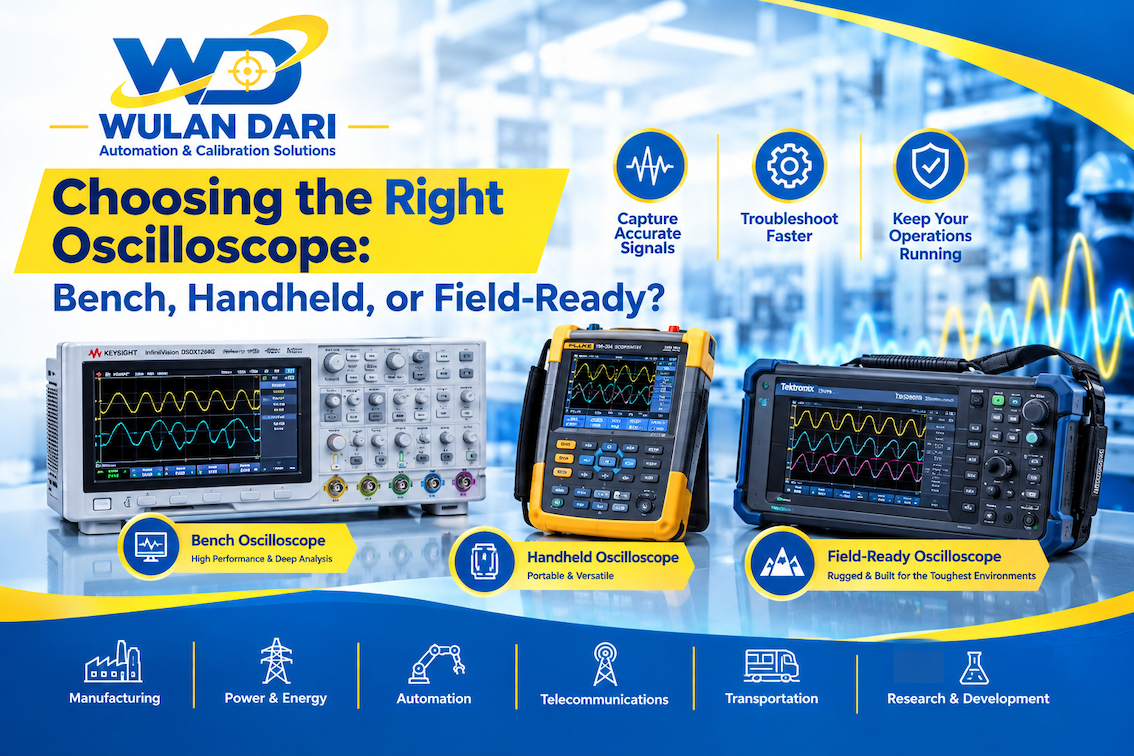
Bench oscilloscopes are the traditional workhorses of electronics design and testing. They are designed for stationary use, typically featuring larger displays, more physical controls, deeper memory, and a wider array of advanced triggering and analysis functions. They are the go-to choice for:
- R&D and Design Validation: Where deep analysis of complex, high-speed digital and analog signals is required.
- Manufacturing Test: Where consistent, repeatable measurements are needed for production quality control.
- Education: Where the focus is on signal visualization and fundamental principles in a stable environment.
When exploring oscilloscopes for the lab, engineers prioritize bandwidth, sample rate, and channel count to match their specific design requirements.
The Power of Portability: Handheld Oscilloscopes
The line between bench and portable instruments has blurred significantly in recent years. Modern handheld oscilloscopes are no longer just simple signal tracers; they are powerful, multi-functional tools that pack the performance of a bench scope into a rugged, battery-powered chassis.
A handheld oscilloscope is indispensable for professionals who need to measure signals in the field, on a production line, or inside a vehicle. Their key advantages include:
- Portability and Mobility: Battery-powered operation and a compact form factor allow for measurements anywhere.
- Safety and Isolation: Many models feature isolated channels, which is a critical safety feature when making floating measurements or working on motor drives and power supplies.
- Ruggedness: Designed to withstand the shocks, dust, and temperature variations typical of industrial environments.
Key Specifications to Consider
Regardless of the type, a few core specifications dictate an oscilloscope’s capability. When reviewing options, pay close attention to:
- Bandwidth: The frequency range the scope can accurately measure. A rule of thumb is to choose a scope with at least 3 to 5 times the bandwidth of the signal you intend to measure.
- Sample Rate: Measured in GS/s (Giga-samples per second), this is how often the scope takes a “snapshot” of the signal. A higher sample rate provides better resolution for fast-changing signals.
- Memory Depth: Measured in Mpts (Mega-points), this determines how long a signal can be captured in a single acquisition. Deeper memory allows for more detailed analysis of longer events.
- Channel Isolation: Essential for safety and accuracy, isolated channels prevent damage and measurement errors when probing circuits with different ground references.
Spotlight: The Keysight U1610A Handheld Oscilloscope
For professionals who demand high performance in a portable package, the Keysight U1610A is a standout choice. It exemplifies the modern handheld oscilloscope by combining robust field features with impressive acquisition specifications.
With 100 MHz of bandwidth, a 2 GS/s sample rate, and 2 Mpts of memory depth, the U1610A is more than capable of capturing and analyzing a wide range of signals. Its two isolated channels are a critical safety and accuracy feature for field engineers. The 5.7-inch color LCD, intuitive interface, and built-in help system make it accessible for users of all skill levels, while USB and Ethernet connectivity ensure seamless data transfer and remote control.
This instrument is a prime example of why a handheld scope is a sound investment for any team that needs to perform diagnostics outside the lab. It provides the confidence of a high-performance acquisition system without sacrificing the mobility required to get the job done.
Conclusion: The Right Tool for the Right Job
Choosing between a bench and a handheld oscilloscope ultimately comes down to the environment of your measurements. A bench scope remains the primary tool for deep design and analysis in a controlled setting, while a high-quality handheld scope is the essential companion for engineers on the move.
At Wulan Dari, we supply a comprehensive range of authentic oscilloscopes from leading brands, including both high-precision bench models and rugged handheld units like the Keysight U1610A. Our team understands the importance of genuine instruments for reliable measurements and long-term value. Based in Batam, Indonesia, we are committed to supporting engineers and technicians across the region with expert advice, competitive pricing, and fast shipping.
Ready to equip your team?
Browse our full range of Oscilloscopes →
Explore our Handheld Oscilloscopes →
Learn more about the Keysight U1610A →
Keyword Tags: handheld oscilloscope, oscilloscope for field service, portable oscilloscope, Keysight U1610A, oscilloscope bandwidth, digital oscilloscope, bench oscilloscope, electrical measurement tools, Wulan Dari